
Confused about plush vs plushie vs stuffed animals?
Hey, you’re not the only one.
Life moves like a fast train, and language changes at lightning speed. That’s why we created this short guide to slow down, clear up the confusion, and finally clarify the distinctions.
These terms are often used interchangeably.
We can hear them in stores, online shops, and everyday conversations. But when you actually compare plush vs plushie, or dig into plushie vs stuffed animals, the differences become clearer.
We’ll simply explain the similarities and differences in plush vs plushie vs stuffed animals so we can use each term correctly.
And yes, they seem the same at first.
But they’re not. Although they have some similarities.
Once we discover how these words relate to each other, you won’t mix up the meanings anymore.
Now, let’s break it down in the simplest way possible.
Plush vs Plushie: What’s the Core Difference?

We’ll begin with what we use in everyday speech.
And we use the word plush, but we also use plushie. And sometimes I get the feeling we use it for the same thing.
That’s exactly where confusion begins.
So, when that is said, what is the key difference in plush vs plushie?
Here it is:
Plush is the material.
And a plushie is a toy made from that material.
More broadly speaking, plush refers to the soft fabric itself.
If you’d like a full breakdown of what plush fabric really is, how it’s made, and what materials are commonly used, you can explore our detailed guide:What Is Plush? Full Guide to Materials, Safety & Care.
A plushie, on the other hand, is an informal word for a soft toy made from plush fabric. In a practical sense, plushie is all about toys.
Simple as that?
Well, not exactly. Language rarely stays that simple or tidy. It is alive.
And has a way of getting a little messy, it can even spark and shift in unexpected ways.
That’s where overlap begins.
What Does Plushie Mean?

The word plushie sounds cute, and this isn’t accidental. It’s on purpose
Plushie comes from plush.
English speakers added the affectionate “-ie” ending. Next, you can find other words that end the same way:
- sweetie
- doggie
- blankie
This small linguistic change softened the word.
So that’s how plush turned into plushie. Plushie sounds so cute, doesn’t it?
Why am I asking this? Because that small change shifted the tone from material to emotion.
What I mean to say is that a plushie in spoken language often feels more personal than a stuffed animal.
It is not just a word. It suggests comfort, warmth, and attachment.
That emotional tone is one of the main differences between plushies and stuffed animals
Why Do People Often Say Plush Instead of Plushie?
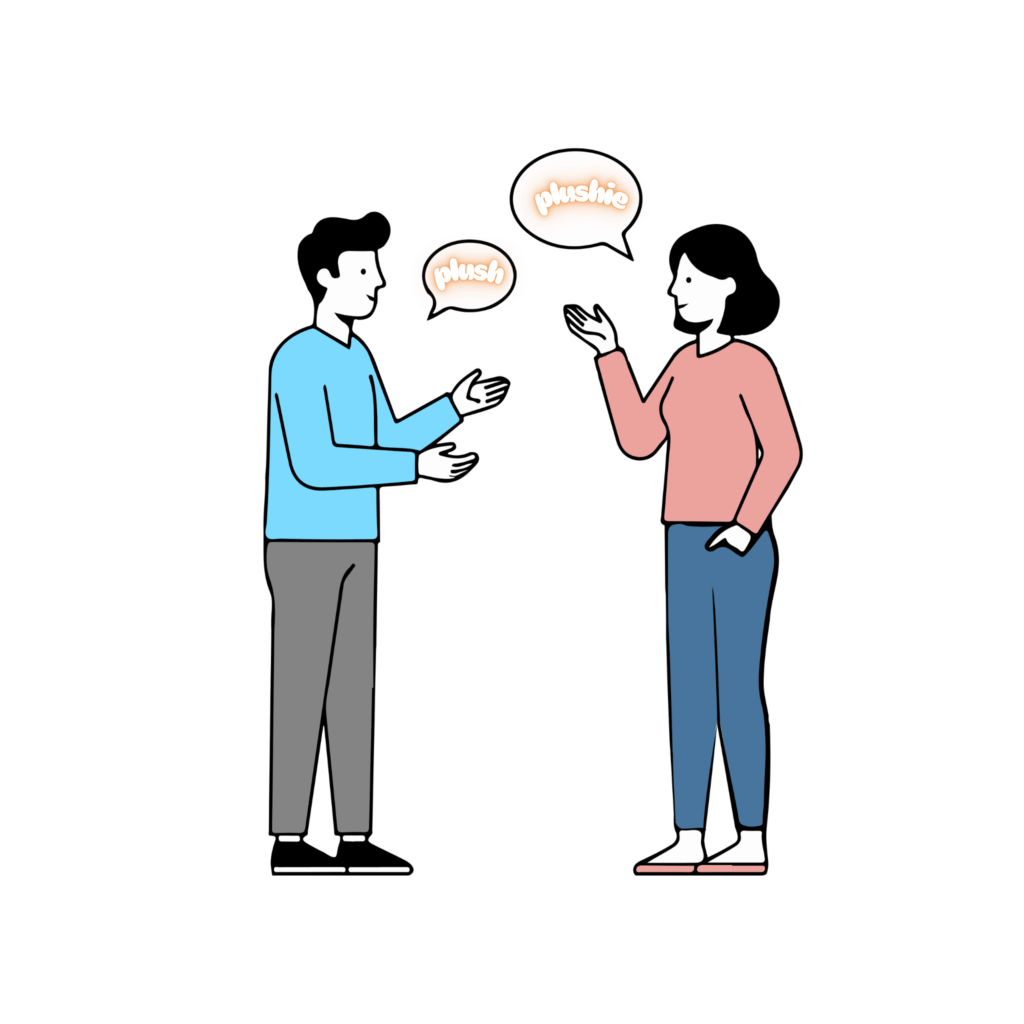
Technically speaking, plush refers to a type of fabric. But in real life, language is a little bit more playful.
And in everyday speech, we tend to simplify language.
That’s why you’ll often hear people say plush when they’re talking about plush toys, especially online or in fan groups.
For example:
When someone says:
“I bought a new plush.”
They almost always mean “I bought a plush toy.” In other words, a soft stuffed animal or character made from plush fabric. This is often called a plushie or plush toy. Over time, people started shortening the phrase to just plush.
In modern English (especially among younger people and online communities), the word plush has taken on a new, informal meaning.
That’s why the two terms often overlap in everyday speech.
If you think this is a bit short and want to know more about what plush fabric actually is, how it’s made, and what goes inside plush products, we’ve got you covered. We go into all those details in our complete guide to plush. We cover that in detail in our complete guide to:
What Is Plush? Full Guide to Materials, Safety & Care
So we won’t dive into details about materials, fillings, or safety here. All that you can read in the main plush guide linked above.
Here, we’re focusing only on how the words relate to each other.
Alright, moving forward.
Plushie vs Stuffed Animals: What’s the Difference?

Now, let’s look at the comparison many of you are looking for:
Plushie vs stuffed animals.
At first glance, they may seem identical. But there’s a subtle difference in tone and scope.
Stick with me and let’s take a look.
Stuffed Animals
A stuffed animal is the traditional American term for a toy that looks like an animal and is made from different fabrics, filled with stuffing.
Stuffed toy makers often choose plush as one of the materials for their products. In that context, stuffed toy is a broader term than plushie.
The term stuffed animal describes two things:
- the shape (animal)
- the construction (filled with stuffing)
If you walk into a toy store in the US, you’ll likely see the aisle labeled Stuffed Animals.
This way, it’s clear, neutral, and descriptive.
Let’s now shift our focus to plushie.
Plushie
A plushie is a softer, more modern term than stuffed toy.
And it usually refers to a plush toy that often carries an emotional tone.
This is where plushie vs stuffed animals becomes interesting.
All stuffed animals made from plush fabric can be plushies.
But not all plushies are stuffed animals.
That’s the key difference in plushie vs stuffed animals.
And plushie doesn’t have to be an animal.
It can be:
- a fantasy dragon
- a cartoon character
- a food shape
- a decorative plush figure
One more thing, let’s clarify another common comparison.
Plush vs Stuffed Animals

This one is easyier.
Plush is a material.
Stuffed animals are animal-shaped toys.
You don’t compare them as equals because they operate on different levels.
One is fabric, and the other is a product category.
Understanding this hierarchy helps us to finally untangle the confusion around plush vs plushie vs stuffed animals.
Now, let’s summarize everything and put it in a table.
Quick Summary: Plush vs Plushie vs Stuffed Animals
| Term | What It Means |
|---|---|
| Plush | Originally, it was a soft fabric. But over time, the word “plush” has taken new, informal meaning and could mean a plush toy. |
| Plushie | A soft toy made from plush fabric, often used in a warmer or more emotional way |
| Stuffed Animals | Animal-shaped toys filled with stuffing. They use different materials on the outside, including plush. |
At first, plush vs plushie vs stuffed animals can sound like the same thing.
But now you know the structure behind the words.
Plush is the material.
Stuffed animals describe a specific type of toy.
Plushie adds warmth and personality to the conversation.
The difference isn’t about right or wrong — it’s about context.
One term focuses on fabric.
One focuses on a category.
One reflects emotion.
Once you see how they connect, the confusion disappears.
And the next time you’re shopping, gifting, or simply talking about a favorite comfort item, you’ll know exactly which word fits the moment.
FAQ
Yes, people consider plushie a more informal term. It comes from the word plush and became popular through online communities and fandom culture. While it isn’t technical language, lots of people use it in everyday conversation.
Absolutely. Adults often say plushie when they’re talking about collectibles, character toys, or comfort items. The word isn’t just for children’s toys.
No. While many stuffed animals are made from plush fabric, some are made from other textiles, such as cotton or felt. Plush refers specifically to a soft fabric type, not the toy category itself.
Both are correct. Plushie is the term people use for a soft, plush toy. Plushy usually refers to something that feels soft, like plush fabric (e.g., “a plushy blanket”), rather than to the toy itself.

